Online casinos by state

Seven states. That’s the entire regulated online casino map in the United States as of mid-2026, a number that has grown by exactly one since 2024, when Rhode Island became the newest state to license real-money online casino play. Everywhere else, the online casino landscape is either nonexistent or filled in by a very different kind of platform.
This page walks through where online casino play is actually legal, how those states regulate it, what fills the gap in the roughly forty states that haven’t gone this route, and how to tell a legitimate operator from one that shouldn’t be taking your money.
Where online casinos are legal right now
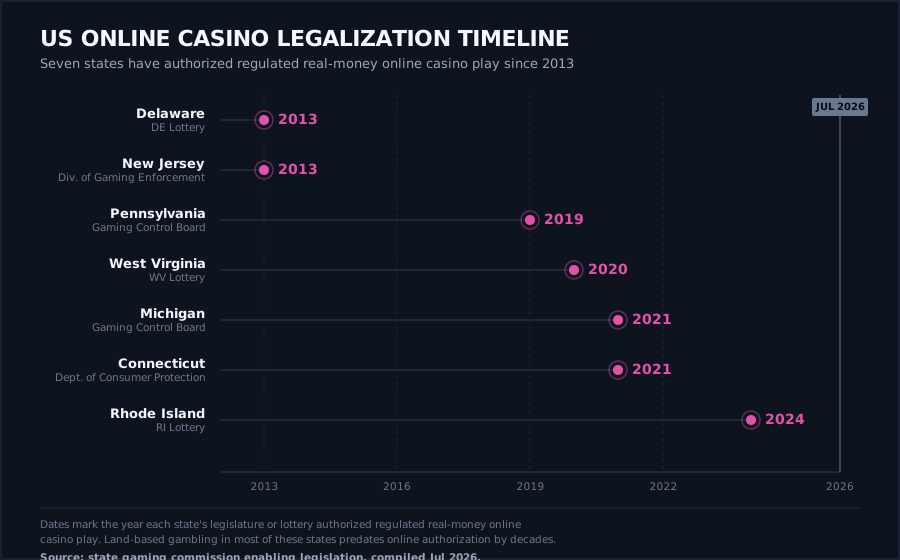
New Jersey, Pennsylvania, Michigan, West Virginia, Connecticut, Delaware, and Rhode Island run regulated, licensed online casino markets. Each ties its online licenses to existing land-based casino operators, or in Connecticut’s case to the state’s two tribal gaming compacts. No two of these seven markets launched the same way, and the gap between the first (New Jersey, 2013) and the most recent (Rhode Island, 2024) is over a decade. For a comparison point outside the US, Alberta’s regulated market opened in 2026 on an open-registration model closer to Ontario’s than to any of the seven.
| State | Legal since | Regulator | Market structure |
|---|---|---|---|
| Delaware | 2013 | Delaware Lottery | State-lottery-operated, single small platform |
| New Jersey | 2013 | Division of Gaming Enforcement | Commercial, tied to Atlantic City casinos |
| Pennsylvania | 2019 | Gaming Control Board | Commercial + Category 4 satellite casinos |
| Michigan | 2021 | Gaming Control Board | Commercial + tribal operators |
| Connecticut | 2021 | Dept. of Consumer Protection | Tribal, two compacts only |
| West Virginia | 2020 | WV Lottery | Commercial resort casinos |
| Rhode Island | 2024 | Rhode Island Lottery | Single-operator, lottery-run |
Each of these states licenses individual online platforms separately. A brand licensed in New Jersey isn’t automatically licensed in Pennsylvania, even if it operates under the same name in both places. That’s a meaningful detail for players who move between states, since an account in one regulated state generally doesn’t transfer to another, and re-registering under a new state’s license is standard rather than an inconvenience unique to any one operator.
Delaware and Rhode Island sit at the small end of this list for a reason worth noting. Both run their online casino markets through the state lottery rather than through a competitive field of licensed commercial brands, which caps how many platforms operate there at any given time. New Jersey, Pennsylvania, and Michigan, by contrast, license multiple competing operators, which is part of why those three states post the largest online casino revenue numbers in the country.
Legal online casinos in the US: state-by-state breakdown
Beyond the seven regulated states, the picture splits into two groups. A handful of states allow online sports betting but stop short of online casino games. New York is the largest example, with a booming mobile sportsbook market and no path yet to online slots or table games, a split covered in detail on the state’s own page below. The rest have no state-level online gambling framework of any kind for casino-style games.
That doesn’t mean nothing is available in those states. Two things typically fill the space. Sweepstakes-model social casinos operate under sweepstakes law rather than gambling law, covered in full on the sweepstakes casinos page. And where the state allows it, tribal or commercial land-based casinos operate with no online counterpart at all. California and Texas fall into that second category: extensive physical casino markets, zero regulated online options, for very different underlying reasons.
Individual state pages on this site go deeper on specific markets, including Florida, California, Texas, New York, Pennsylvania, and Michigan. Each covers the specific legal history and land-based context behind that state’s status, rather than repeating the same general explanation with the state name swapped in.
Embed this graphic
Legal gambling age for online casinos in the US
Every regulated online casino state sets the minimum age at 21, matching the age requirement at the state’s physical casinos. This is consistent across all seven states. There’s no regulated market where 18-year-olds can legally play real-money online casino games, which differs from some other forms of gambling: several states set the minimum age for lottery play or certain types of pari-mutuel wagering lower than casino gambling.
Sweepstakes-model platforms are a different legal category and commonly set their minimum age at 18, though the exact threshold depends on the individual platform’s terms and the state it operates in. Age verification at regulated online casinos happens during account registration and is checked against government-issued ID, not just a self-reported birthdate, and a failed age check at sign-up typically ends the registration attempt outright rather than flagging it for later review.
How online casinos verify your state
Regulated online casinos are legally required to confirm a player is physically located within a licensed state for every session, not just at sign-up. That’s handled through geolocation software running in the background on desktop and mobile, layered on top of GPS, WiFi network data, and IP address checks. Crossing a state line mid-session, driving from New Jersey into Pennsylvania for instance, triggers a location re-check and can pause play if you land somewhere the platform isn’t licensed.
This geolocation check runs separately from identity verification, or KYC, which confirms who you are once at sign-up using your legal name, address, date of birth, and often the last four digits of a Social Security number. The two systems solve different problems. Geolocation answers “are you allowed to play here right now.” Identity verification answers “are you who you say you are.”
How to check a casino’s license
Every regulated state publishes its list of licensed operators publicly. The Division of Gaming Enforcement in New Jersey, the Gaming Control Board in Pennsylvania, and their counterparts in the other five states all maintain online registers that name every currently licensed platform. Checking a specific casino against that register, rather than trusting a “licensed and regulated” badge on the site itself, is the only verification that actually confirms anything. The check itself takes less time than reading a single page of terms and conditions.
Spotting an unlicensed operator
The clearest warning sign is a platform accepting real-money deposits from a state where it holds no license at all. No license means no regulator has jurisdiction if a dispute over a withdrawal or a locked account comes up. There’s no state agency to file a complaint with, and no enforcement mechanism forcing the platform to make good on a disputed payout.
A second, subtler sign is vagueness. A legitimately licensed casino states its license number and issuing regulator explicitly, because that license is the entire legal basis for the site’s operation. Evasiveness on that point, or marketing language that references licensing in general terms without naming a specific state or number, is worth treating as a signal on its own rather than dismissing as an oversight.
Deposits, withdrawals, and payout times
Deposits at regulated online casinos generally clear immediately across card, bank transfer, and e-wallet methods. Withdrawals move slower, typically one to five business days once identity verification is complete, with e-wallet withdrawals through services like PayPal or Skrill usually processing faster than a bank transfer back to a debit card. A more detailed breakdown of payout speed by method, including how return-to-player percentage factors into comparing casinos, lives on the best payout online casinos page.
Online casino bonuses and wagering requirements
Welcome bonuses at regulated online casinos are tied to a first deposit and typically match some percentage of that deposit up to a cap. The number that actually matters is the wagering requirement: how many times you need to bet the bonus amount before it becomes real, withdrawable money. A 25x wagering requirement on a $100 bonus means $2,500 in total wagers before that bonus balance converts to cash you can withdraw.
Reading the specific terms before opting into a bonus is worth the few minutes it takes, because these terms genuinely differ enough between operators to matter. Some platforms also exclude certain games from counting toward wagering requirements entirely, most commonly live dealer tables and certain jackpot slots, which can quietly extend how long it actually takes to clear a bonus.
Mobile casino gaming
All seven regulated states support mobile play, either through a dedicated app or a mobile-optimized website, and the game libraries are functionally identical to desktop. Geolocation checks run the same way on mobile as on desktop, through a combination of GPS and network data, so the same state-boundary rules apply whether you’re playing from a laptop at home or a phone on the move within your state.
Responsible gambling resources
Every regulated online casino is required to offer deposit limits, loss limits, cool-off periods, and self-exclusion tools, and most regulated states run a state-wide self-exclusion register that covers every licensed operator at once rather than requiring a separate opt-out per platform. If gambling has stopped being fun, the national helpline, 1-800-GAMBLER, is free, confidential, and available around the clock. More detail is available on the responsible gambling page.
Finding the right regulated online casino
The starting point isn’t which casino has the flashiest homepage. It’s whether your state regulates online casino play at all, and if so, which platforms hold a license there. From there, payout speed, game selection, and bonus terms are the differentiators worth comparing. If your state isn’t on the list of seven, the sweepstakes-casino model, covered separately, is the legal alternative most players end up looking at.
Game selection itself is worth a closer look once licensing is settled: live dealer casinos replicate a physical table over video stream, while online blackjack and online roulette remain the two highest-volume table games across every regulated state’s platform library.